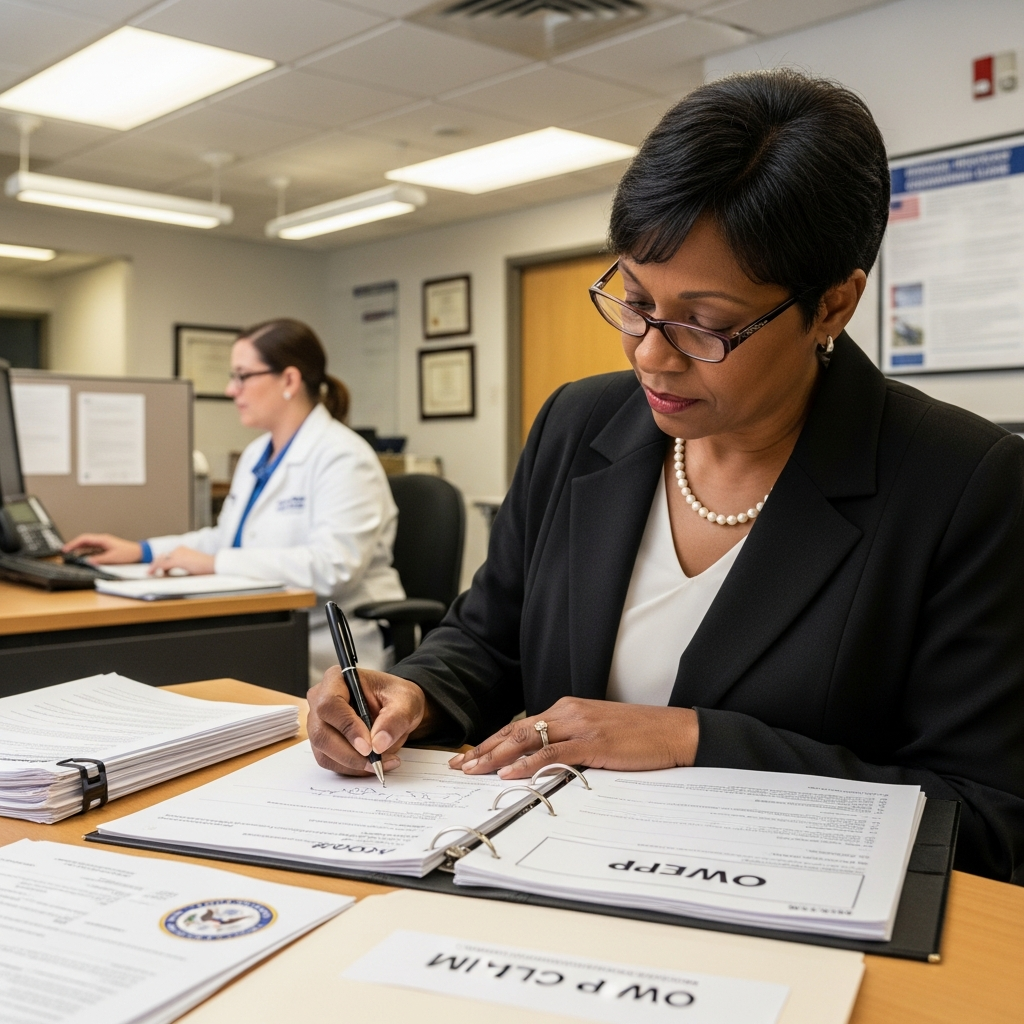
Brooklyn OWCP Forms: Filing Best Practices

Picture this: You’re a postal worker, a transit employee, maybe someone who spends their days keeping Brooklyn’s infrastructure humming along. You got hurt on the job – not because you were careless, but because the work is physical, unpredictable, and sometimes unforgiving. Now you’re sitting at your kitchen table, staring at a stack of government forms that might as well be written in ancient Sanskrit, wondering how a paperwork mistake could cost you the benefits you genuinely need and deserve.
That feeling? That low-grade panic mixed with exhaustion and frustration? It’s more common than you’d think.
The Office of Workers’ Compensation Programs – OWCP, if you want to use the acronym everyone throws around – handles federal workers’ compensation claims. And if you’re a federal employee in Brooklyn, navigating this system is just… part of the reality when a workplace injury turns your life sideways. The problem is, the system wasn’t exactly designed with human beings in mind. It was designed by bureaucrats, for bureaucrats, and somewhere along the way, the actual injured worker got lost in the fine print.
Here’s what nobody tells you upfront: the forms themselves are often where claims live or die. Not the injury. Not the medical evidence. The forms.
A missed deadline here, an incomplete field there, the wrong code in a box you didn’t even realize mattered – and suddenly your claim is delayed, disputed, or denied entirely. We’ve seen it happen to experienced federal employees who absolutely knew their rights but didn’t know the paperwork. It’s genuinely unfair. And it’s genuinely preventable.
Brooklyn presents its own particular set of circumstances, too. You’ve got a dense concentration of federal employees – postal workers, VA hospital staff, Social Security Administration employees, federal court workers, Border Patrol, the list goes on. The Brooklyn federal workforce is enormous, and that means the volume of OWCP claims moving through the system is substantial. Which means errors get caught quickly, processing queues can be unforgiving, and the margin for mistake is slimmer than people realize.
Actually, that reminds me of something worth saying early: this isn’t about doubting yourself or assuming you’ll mess things up. It’s about understanding that even smart, capable people get tripped up by OWCP paperwork because the system is genuinely complex. There’s no shame in that. The shame would be in not learning how to do it right.
So what does “right” actually look like?
That’s exactly what this guide is going to walk you through. We’re going to talk about the core OWCP forms you’ll encounter – the CA-1 for traumatic injuries, the CA-2 for occupational diseases, and several others you’ll meet along the way depending on your situation. We’ll get into timing, because deadlines in this system are not suggestions, and missing them creates problems that can follow a claim for months. We’ll talk about how to document everything properly, how to work with your treating physicians to get the medical evidence that actually supports your claim, and some of the most common mistakes Brooklyn filers make that you can absolutely avoid.
We’ll also touch on something people don’t always think about at the beginning – what happens after you file. The back-and-forth with OWCP, responding to requests for additional information, understanding what your rights are when something doesn’t go the way you expected.
None of this requires a law degree. It does require attention, patience, and – honestly – a willingness to treat your claim like it matters. Because it does. These benefits exist because you were hurt doing your job. Protecting them starts with understanding the paperwork that protects you.
If you’re at the beginning of this process, feeling overwhelmed, you’re in the right place. If you’ve already filed something and you’re not sure you did it correctly… also the right place. And if you’re the kind of person who just wants to understand the system before anything goes wrong – genuinely, that’s the smartest approach anyone can take.
Let’s get into it.
What OWCP Actually Is (And Why It Trips People Up)
So let’s start with the basics, because honestly, the acronym alone throws people off. OWCP stands for the Office of Workers’ Compensation Programs – it’s the federal agency that handles injury claims for federal employees. Not state workers, not private sector employees. Federal.
This matters a lot if you’re in Brooklyn, because we’ve got a significant federal workforce here – postal workers, court employees, VA hospital staff, federal corrections officers, dock workers covered under the Longshore Act… the list goes on. If you work for a federal agency and you get hurt on the job, OWCP is your system. Not New York State workers’ comp. Different animal entirely.
And that distinction? It confuses people constantly. Someone gets hurt, assumes their claim goes through the state, and then wonders why everything feels off. It’s like showing up to JFK with a bus ticket – you’re not wrong that you want to travel, you’ve just got the wrong system entirely.
The Three Main Programs Under the OWCP Umbrella
Here’s where it gets a little layered – because OWCP isn’t actually one single program. It’s more like a building with three different offices inside.
The Federal Employees’ Compensation Act (FECA) covers most civilian federal employees. Think postal workers, federal office staff, TSA agents. This is the one most people in Brooklyn are dealing with.
The Longshore and Harbor Workers’ Compensation Act (LHWCA) covers maritime workers and certain other categories – relevant here given Brooklyn’s working waterfront history and ongoing port activity.
The Federal Black Lung Program is specific to coal miners, so unless you’ve got an unusual work history, this one probably doesn’t apply to you.
Why does knowing your program matter? Because each one has its own forms, its own deadlines, and its own quirks. Filing the wrong paperwork under the wrong program is a surprisingly common mistake, and it wastes time you really can’t afford to waste.
The Forms Themselves – A Brief, Honest Orientation
Okay, this is the part people genuinely find confusing, and it’s okay to admit that. The form numbering system doesn’t follow obvious logic. It doesn’t build neatly from CA-1 to CA-2 to “and now you understand everything.” It’s more like a filing cabinet that someone organized in 1974 and nobody’s fully reorganized since.
The most common forms you’ll encounter under FECA
CA-1 is for traumatic injuries – a single incident with a clear moment it happened. You slipped on a wet floor. A door hit you. That kind of thing.
CA-2 covers occupational diseases or illnesses that developed over time. Repetitive stress injuries, hearing loss from chronic noise exposure, conditions that built up gradually. The distinction between CA-1 and CA-2 matters more than you’d think – filing the wrong one can actually delay your claim.
CA-7 is the wage loss claim form, used when you’re out of work and need compensation for lost wages. This one comes into play after the initial injury forms are submitted.
There are others – CA-16 authorizes medical treatment, CA-20 is for the physician’s report – but you get the idea. There’s a form for most things.
The Timeline Problem Nobody Warns You About
Here’s something counterintuitive that catches a lot of people off guard. OWCP has strict reporting deadlines, and they’re not generous. For traumatic injuries under FECA, you’re supposed to report within 30 days of the injury. For occupational disease claims, it’s within 30 days of when you first realized (or should have reasonably realized) that your condition was work-related.
Miss those windows and you’re not automatically disqualified – but you will face extra scrutiny and potential complications. It’s like trying to return something to a store after the return window closes. Maybe they’ll work with you, maybe they won’t, but it’s definitely harder.
The tricky part with occupational diseases is that “when you should have known” question. It’s genuinely fuzzy. When does a sore back become something you connect to years of lifting at a postal facility? These judgment calls are exactly why documenting everything from the start matters so much.
Your Employer Is Part of This Process
One thing that surprises people – your federal employer doesn’t just step back and let you file on your own. They have their own obligations and their own sections to complete on your forms. The claim is collaborative in structure, even when the relationship with your supervisor feels anything but. Getting your agency’s paperwork completed accurately and on time is part of your claim’s foundation – and yes, that sometimes gets complicated.
Know Your Forms Before You Need Them
Here’s something most people don’t find out until it’s too late – the OWCP system has very little patience for “I didn’t know.” The CA-1 (traumatic injury) and CA-2 (occupational disease) forms aren’t interchangeable, and filing the wrong one can delay your claim by weeks or even months. If your injury happened in a single incident – a slip, a fall, a sudden strain – that’s a CA-1. If it developed over time, repetitive stress, chronic back pain from years of lifting, hearing loss from constant noise exposure – that’s a CA-2. Get this wrong and you’re not just slowing things down. You’re potentially creating a paper trail that contradicts your own claim.
Take twenty minutes right now, before anything happens, to download both forms from the Department of Labor’s OWCP portal and actually read them. Sounds boring. Do it anyway.
Document Everything From Day One
The moment an injury happens – or the moment you *realize* something has been building – your documentation clock starts ticking. And Brooklyn federal employees often lose claims not because their injuries weren’t real, but because their records were thin.
Here’s what that actually looks like in practice
Write down the date, time, location, and exactly what happened within 24 hours. Don’t trust your memory. Include who was nearby, what you were doing, and what you felt immediately afterward. If you reported it to a supervisor, note that conversation word for word if you can. Keep a running log – even just notes in your phone – of every symptom, every doctor visit, every day you couldn’t perform your full duties. This becomes gold later when OWCP reviewers start asking questions.
And photographs? Take them. Of the scene, of any visible injury, of equipment that malfunctioned. Evidence that feels overly cautious now will feel absolutely necessary in six months.
The Supervisor Report Is a Landmine – Navigate It Carefully
This is the part nobody warns you about clearly enough. When your supervisor fills out their portion of Form CA-1 or CA-2, what they write matters enormously. A skeptical supervisor, or honestly just a careless one, can phrase something in a way that creates doubt about your claim – even unintentionally.
You have the right to see what they’ve written. Request a copy before it goes anywhere. If there are factual inaccuracies, address them in writing immediately – not in a confrontational way, but documented. Something like “I wanted to clarify the description of the incident for the record…” goes a long way. Keep it factual. Keep it professional. But don’t let errors sit there unchallenged.
Brooklyn-Specific Timing You Can’t Ignore
Federal employees in New York have to file a CA-1 within 30 days of injury to claim continuation of pay. After that 30-day window? You can still file, but COP gets much harder to secure. The overall filing deadline extends to three years, but the practical protections shrink fast.
One thing that trips up a lot of Brooklyn postal workers and federal agency employees specifically – the distance to the nearest OWCP district office means mail delays actually matter. Send everything certified mail with return receipt. Every. Single. Time. Keep copies of absolutely everything you submit. Create a dedicated folder, physical or digital, where every piece of correspondence lives. Future you will be incredibly grateful.
Don’t Skip the Second Opinion Option
If OWCP sends you to their designated physician and you disagree with the findings… you’re not stuck. You have the right to submit a report from your own treating physician, and if there’s a conflict, a second referee physician can be involved. This process feels intimidating but it’s legitimate and it works.
Choose a treating doctor who understands OWCP cases specifically – this is genuinely important in a way that’s hard to overstate. A physician unfamiliar with federal workers’ compensation language will write notes that, however accurate medically, don’t map onto what OWCP reviewers are looking for. Ask around. Find someone who’s navigated this before.
When to Get Help
If your claim gets denied, or if you’re receiving confusing letters, or honestly if the paperwork just feels overwhelming – reaching out to a OWCP claims specialist or an attorney who handles federal workers’ comp isn’t admitting defeat. It’s being strategic. The system is genuinely complicated, and professionals who do this daily know shortcuts and pitfalls that aren’t written in any official guide.
Your health and your livelihood are both on the line here. Treat this process with the seriousness it deserves.
The Paperwork Maze Nobody Warned You About
Let’s be honest – filing OWCP forms in Brooklyn isn’t exactly a smooth, well-lit path. It’s more like navigating the subway at rush hour when two lines are suspended and nobody’s updated the signs. The process has real friction points, and pretending otherwise doesn’t help you.
Here’s what actually trips people up, and what you can do about it.
Your Injury Description Needs to Be Specific (Like, Really Specific)
One of the most common reasons OWCP claims get delayed or denied is vague injury descriptions. People write something like “hurt my back at work” and think that covers it. It doesn’t. The Office of Workers’ Compensation Programs wants to see exactly how, when, and where the injury occurred – the mechanism of injury, the specific body part affected, and a clear causal link to your job duties.
The fix here isn’t complicated, but it does require some patience. Write your description in plain, detailed language. “While lifting a mail bin weighing approximately 40 pounds on March 3rd at the Flatbush distribution facility, I felt a sharp pain in my lower back” is infinitely better than “back injury from work.” Actually, think of it like filing a police report – the more specific, the better your case.
The Form CA-1 vs. CA-2 Problem
This one confuses almost everyone. CA-1 is for traumatic injuries – something that happened at a specific moment. CA-2 is for occupational diseases – conditions that developed gradually over time. Using the wrong form doesn’t just slow things down… it can result in a rejection that eats weeks of your time.
If you developed carpal tunnel syndrome from years of repetitive data entry? CA-2. If you slipped on a wet floor in a federal building? CA-1. When you’re genuinely unsure – and sometimes the line really is blurry – consult with your agency’s OWCP coordinator before you file. Don’t guess.
Medical Documentation Gaps
Here’s where a lot of Brooklyn federal workers unknowingly sink their own claims. They file promptly (good!), but their supporting medical documentation is thin, late, or from a provider who isn’t familiar with OWCP requirements.
OWCP doesn’t just want a note saying you’re hurt. They want medical evidence that establishes a direct relationship between your diagnosed condition and your work. That means your treating physician needs to actually connect those dots in their documentation – not just describe your symptoms.
The practical solution? Choose a doctor who has experience with OWCP cases, or at minimum, brief your physician on what’s required before your appointment. Bring documentation of your job duties. Explain what you do physically at work. Help your doctor help you.
Deadline Anxiety (And Missing Them)
The three-day waiting period, the 10-day filing window for traumatic injuries, continuation of pay requirements – there are a lot of dates swirling around. And when you’re in pain, possibly dealing with a sudden income disruption, tracking all of this feels overwhelming.
Here’s the thing though: not all missed deadlines are fatal to your claim. Some can be explained and worked around. But you need to address them head-on, not hope nobody notices. Document *why* something was late. Was you hospitalized? Was there a delay in your agency’s response? Paper trails matter enormously here.
Set phone reminders. Ask a trusted coworker or family member to help you track dates. And if you’re already past a deadline, don’t give up – explain the circumstances in writing.
The “I’ll Handle It Later” Trap
Maybe the sneakiest problem of all. People get hurt, they’re focused on recovery, and the paperwork piles up on the kitchen table while they tell themselves they’ll deal with it when they feel better. Totally understandable. Also genuinely risky.
Delays give insurance examiners reasons to question whether the injury was as serious as claimed. They create gaps in the record. And honestly, memory fades – your recollection of exactly what happened on a specific workday three months ago will be hazier than it was the week it happened.
File promptly. Get the basic forms submitted even if your medical documentation is still being assembled. You can supplement later. Getting something on record quickly is almost always better than waiting for everything to be perfect.
When to Ask for Help
If your claim is complex – if there’s a dispute about whether your injury is work-related, if you’re dealing with a pre-existing condition, or if your agency is being unresponsive – please don’t white-knuckle it alone. An OWCP specialist or workers’ compensation attorney familiar with federal claims can be worth every penny.
What to Actually Expect After You File
Let’s be honest with you here – the OWCP process is not fast. It’s not meant to punish you, it’s just a federal bureaucracy with an enormous caseload, and Brooklyn claimants are dealing with a system that processes claims from workers all over the country. If you’re expecting a phone call within a week saying “great news, everything’s approved,” you’re probably going to be disappointed. And we’d rather you know that now than feel blindsided later.
A realistic timeline for an initial decision on a traumatic injury claim? Think 30 to 45 days from the date your CA-1 is received and accepted. That’s if everything is in order. If your forms have missing information, if your supervisor’s signature is delayed, if your medical evidence needs clarification – that clock essentially resets. Occupational disease claims filed on a CA-2 tend to take even longer, sometimes several months, because the causal relationship between your work and your condition requires more investigation on their end.
This isn’t us trying to scare you. It’s just… reality.
The Waiting Period Nobody Warns You About
Here’s the part that catches a lot of workers off guard. Even after you’ve filed everything correctly, there’s often a period of silence. No updates. No correspondence. Just waiting. OWCP isn’t great at proactive communication – you’ll likely need to check your claim status through the ECOMP portal yourself, or have your supervisor or union rep help you track it.
During this window, a few things are quietly happening. Your claim is being assigned to an examiner. Your employer is being given an opportunity to contest or provide input. Your medical documentation is being reviewed. It’s a lot of moving parts, and none of them are particularly visible to you as the claimant.
Keep filing your medical paperwork in the meantime. Don’t wait for an approval letter to get treatment documented. Actually – this is one of the biggest mistakes people make – they pause on gathering records because they assume the claim will just work itself out. It won’t. Keep every appointment. Keep every receipt. Keep requesting chart notes from your providers.
When You Get a Decision – What It Might Look Like
Your first decision letter might not be the final word on anything. OWCP decisions come in a few flavors. A full acceptance means your claim is approved and compensation can begin flowing. A limited acceptance might cover some conditions but not others. And a denial… well, that’s not the end of the road either, even though it feels that way.
If you receive a denial, you have the right to request a hearing before an OWCP district medical adviser, or to submit additional evidence for reconsideration. The reconsideration window is typically one year from the date of the decision letter. Miss that window, and your options get significantly narrower. So if a denial lands in your mailbox, the worst thing you can do is set it aside and deal with it later.
A lot of Brooklyn federal workers – especially those who’ve never navigated OWCP before – don’t realize that a first denial isn’t necessarily a final answer. It often just means the initial package of evidence wasn’t quite enough.
Your Immediate Next Steps Right Now
If you haven’t filed yet, file now. Not next week. The continuation of pay protections on traumatic injuries only hold for a limited window, and delays genuinely cost you.
If you’ve already filed, here’s what to focus on
– Stay in contact with your treating physician and make sure they understand this is a workers’ comp case – they’ll need to document work-relatedness specifically – Follow up with your supervisor to confirm your forms were forwarded to the agency’s OWCP office promptly – Document everything – dates, names, phone calls, emails, any communication related to your claim – Create a simple folder (physical or digital, whatever works for you) where every piece of correspondence lives
And if the whole thing feels overwhelming – which is completely understandable, because it is a lot – consider reaching out to a workers’ compensation attorney who handles OWCP cases, or connect with your union representative if you have one. You don’t have to figure this out alone.
The process has its frustrations. But filing correctly, staying organized, and setting realistic expectations puts you in a genuinely better position than most claimants. That matters.
Filing federal workers’ comp paperwork isn’t exactly anyone’s idea of a good time – and if you’re dealing with an injury on top of it, the whole process can feel genuinely overwhelming. That’s completely understandable. These forms matter enormously, and getting them right while you’re also trying to heal, manage your finances, and navigate the federal bureaucracy? That’s a lot to carry.
The good news – and there really is good news here – is that you don’t have to figure it out alone. Most of the mistakes that derail OWCP claims aren’t because people weren’t trying hard enough. They happen because the system is complicated, the deadlines are strict, and nobody hands you a roadmap when you get hurt on the job. A missed checkbox here, a vague medical description there… these small things can create big delays in benefits you’ve genuinely earned.
What to Hold Onto as You Move Forward
The biggest takeaways from all of this? Timing matters more than most people realize. File as soon as possible, document everything as specifically as you can, and never assume a form is “probably fine” if you’re not sure. That nagging doubt in your stomach is usually worth listening to.
Keep copies of absolutely everything. It sounds tedious – and honestly, it is – but having a paper trail has saved more than a few claims that might otherwise have stalled. Think of it like keeping your receipts after a big purchase. You hope you never need them. You’re really glad you have them when you do.
And if your claim has already hit a snag, that’s not the end of the road. Appeals exist for a reason, and plenty of initially denied claims have been successfully reversed with the right documentation and support.
You’ve Got More Support Than You Think
Brooklyn’s federal workforce is huge – postal workers, transit employees, healthcare workers, administrative staff across dozens of agencies – and claims come in every shape and size. The specifics of your situation matter, and what worked for your coworker’s claim might not be the right approach for yours. That’s not a reason to panic. It’s a reason to get guidance tailored to you.
If any part of this process has left you feeling confused, stuck, or just a little anxious about whether you’ve done things correctly… reaching out for a consultation is genuinely worth considering. Not because something is necessarily wrong, but because having someone knowledgeable look at your situation can bring a lot of peace of mind. And sometimes, they catch something small before it becomes something significant.
There’s no pressure, no obligation, and no such thing as a question that’s too basic. Whether you’re just starting your claim, waiting on a decision, or trying to understand why something got denied – our team works with Brooklyn federal employees through exactly these situations every day. We actually like untangling this stuff so you don’t have to.
You worked hard. You got hurt. You deserve the benefits that are there to protect you – and you deserve to feel supported while you pursue them. Reach out whenever you’re ready. We’re here.